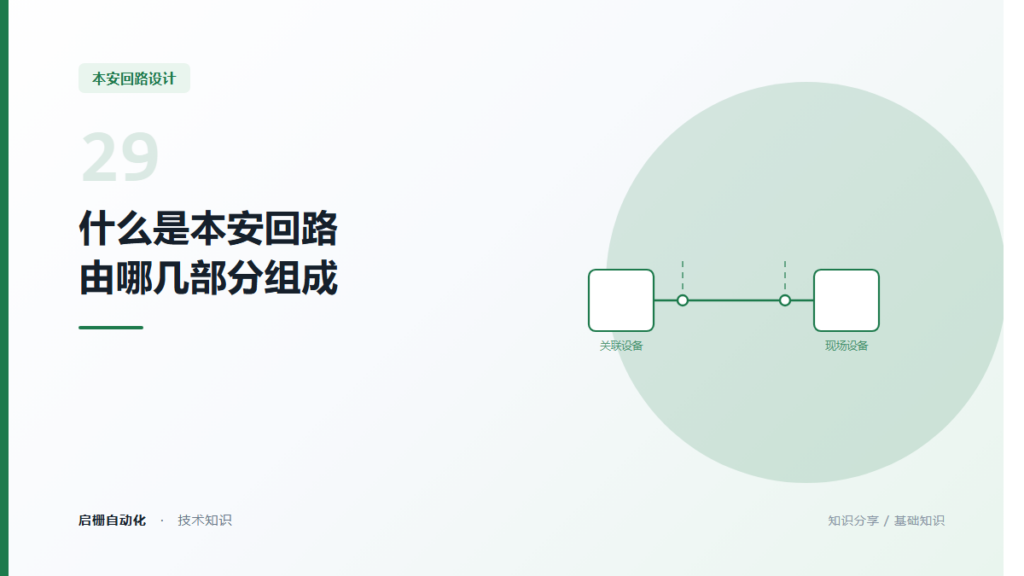
An intrinsically safe circuit (intrinsically safe system) refers to an electrical system consisting offield intrinsically safe equipment, associated apparatus and connecting cables— three parts that together pass energy verification. If any one of the three changes, the system must be re-evaluated.
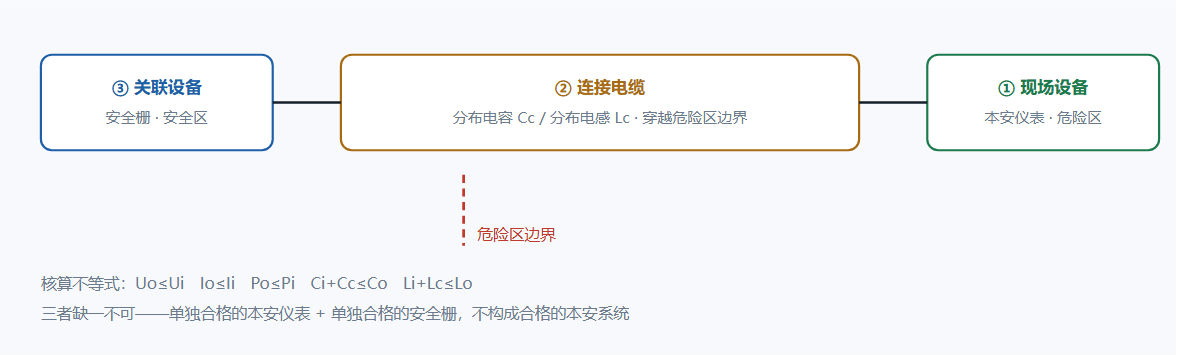
The role of each of the three parts
- Field equipment (intrinsically safe equipment): determines the circuit's
Ui / Ii / Pi / Ci / Li, i.e. how much energy it can withstand and how much stored energy it contains itself; - Associated apparatus (safety barrier): determines the circuit's
Uo / Io / Po / Co / Lo, i.e. how much energy it can output and how much capacitance and inductance it permits to be connected externally; - Connecting cables: introduce distributed capacitance
Ccand distributed inductanceLc, these two items grow linearly with length and are the most easily overlooked variables.
A common misjudgement:"This transmitter is intrinsically safe, so just connect it directly to the DCS." No. Intrinsically safe equipment must pass through associated apparatus to enter the safe area; otherwise it receives unrestricted energy and its intrinsically safe property is immediately void. Intrinsically safe equipment does not "come with protection" — it "requires matching protection".