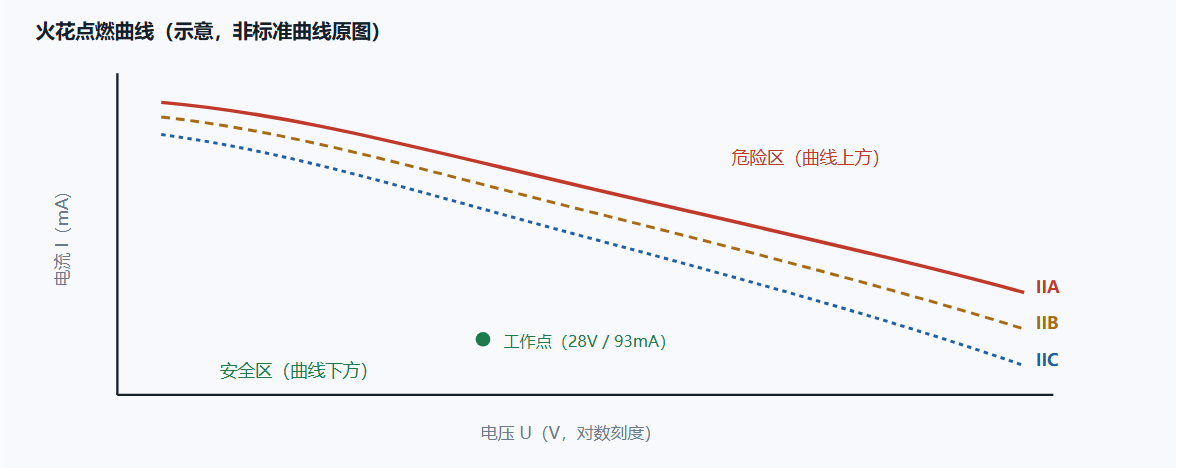
The spark ignition curve is the theoretical basis of intrinsic safety standards: under specific test conditions, different voltage and current combinations are used to ignite specific groups of explosive gases; the combinations that can ignite form a boundary curve, and the region below the curve is considered safe.
How to use it
- When applying for certification, safety barrier manufacturers have already verified their
Uo/IoThe combination will not ignite gases of the corresponding group, so users do not need to check the curves themselves; - Only when users performnon-standard loop calculations(e.g. combining components themselves, long-cable stored energy) is it necessary to judge according to the curves;
- The curves are divided into three groups by gas group: IIC, IIB and IIA. The IIC curve is positioned lowest and is the most stringent.
Why IIC equipment can cover IIA/IIB:IIC has the lowest ignition threshold; if a device does not ignite under IIC conditions, it naturally will not ignite under the more easily ignited IIA/IIB conditions. The coverage relationship derives from the relative positions of the curves, not from arbitrary stipulation.