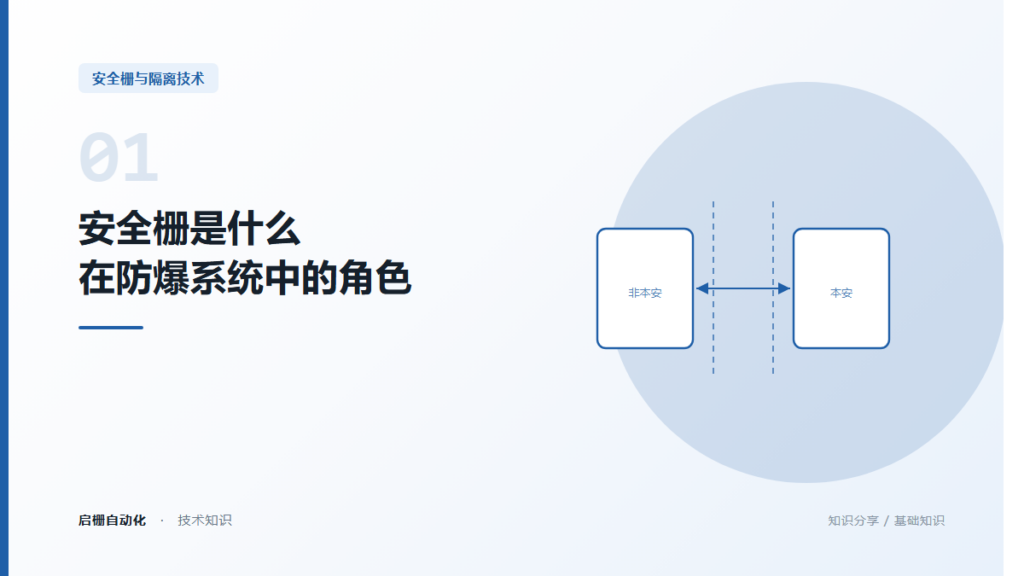
A safety barrier is installed on the safe-area side of an intrinsically safe loopsafe area, its function being to limit the electrical energy entering the hazardous area to a level below that which could ignite an explosive atmosphere. It is connected in series between the control-room instrument and the field intrinsically safe instrument, on the one hand transmitting measurement signals such as 4–20 mA normally, and on the other hand never permitting the output of energy sufficient to ignite into the hazardous area under any fault condition.
In one sentence, its role is:A safety barrier is neither a measuring instrument nor the explosion-proof instrument itself, but a "gate for energy". The explosion protection rating of the field instrument is determined by the instrument's own Ex certificate, while the safety barrier determines the maximum energy permitted to enter the hazardous area through this loop.
Its position in the system
- Control-room side: the I/O cards of the DCS / PLC / safety instrumented system, which are safe-area equipment;
- Safety barrier: installed in the control-room cabinet or on the safe-area side of the field analyser shelter;
- Field side: intrinsically safe transmitters, thermocouples, switches, solenoid valves, etc., located in the hazardous area.
It is precisely because the safety barrier is installed in the safe area that its failure modes are controllable — this determines the fundamental engineering difference between intrinsic safety (Ex i) and flameproof protection (Ex d): flameproof relies on the enclosure withstanding an internal explosion, whereas intrinsic safety eliminates the ignition source at source by limiting energy.
Common misconception:"With a safety barrier installed, the field instrument is explosion-proof." This is not valid. The safety barrier only limits energy; the field instrument itself must still hold a valid intrinsic safety certificate, and its
Ui / Ii / Pi / Ci / Limust match the safety barrier'sUo / Io / Po / Co / Lo. If any one of the three is missing, the system does not constitute an intrinsically safe system.