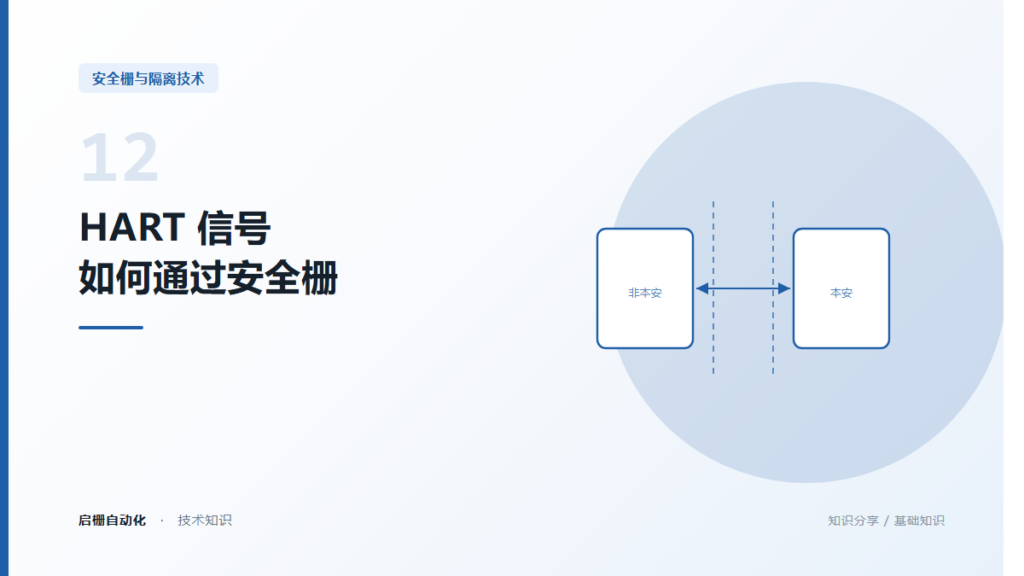
HART is a frequency-shift keying (FSK) signal of approximately ±0.5 mA superimposed on the 4–20 mA DC, at frequencies of 1200 Hz (logic 1) and 2200 Hz (logic 0). For a safety barrier, the DC portion must be energy-limited while the AC portion must be passed through — these two requirements pull against each other.
Prerequisites for passing
- The barrier is explicitly marked HART-compatible/pass-through: not all 4–20 mA barriers can pass HART; the filter capacitors of ordinary barriers bypass the 2.2 kHz signal;
- Sufficient loop impedance: HART communication requires a total loop impedance of no less than approximately 230 Ω (including the 250 Ω sampling resistor); if the impedance is too low, the FSK signal amplitude is insufficient and the handheld terminal cannot connect;
- Energy-limiting parameters are unaffected: HART-compatible designs are achieved by frequency compensation on the energy-limiting circuit; Uo/Io/Po remain unchanged and the explosion protection parameters remain valid.
On-site troubleshooting sequence:When the handheld terminal cannot connect, first measure the loop resistance on the safe-area side; then check whether the barrier model is marked HART; finally confirm whether the handheld terminal connection point spans the 250 Ω resistor. Only if all three are ruled out should the instrument be suspected. Reversing the sequence wastes a great deal of time on removing instruments.
When configuring an intrinsically safe transmitter, there is one more constraint:The handheld terminal or HART modem must be connected on the safe-area side, and must not be taken into the hazardous area for connection. This is not a matter of operating habit but a rule of the intrinsically safe system boundary—any device connected in the hazardous area must be intrinsically safe or an approved associated apparatus.