The principle of Intrinsic Safety (designated Ex i) is:rather than withstanding an explosion, ensure that the energy can never reach the threshold required for ignition. By limiting the voltage, current, power and stored energy in the circuit, the electrical sparks and thermal effects produced by the equipment under normal operation and specified fault conditions are insufficient to ignite an explosive atmosphere.
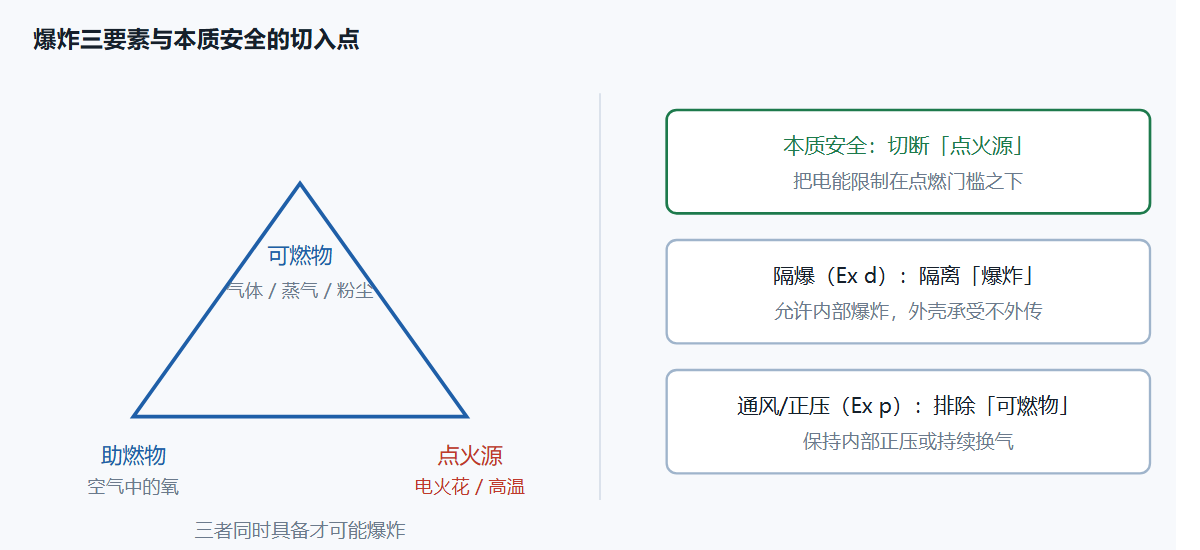
Three characteristics of the intrinsically safe type
- Live opening and maintenance permitted: the energy itself is limited, so the enclosure can be opened for inspection and repair on site while energised, and measurements can be taken with an intrinsically safe multimeter; this is its greatest engineering advantage over the flameproof type;
- Suitable for Zone 0: the ia category is the only protection type permitted for Zone 0 (explosive atmosphere continuously present);
- System property: intrinsic safety is not a property of a single device but a system property formed jointly by the "field device + associated apparatus + cable", and must be verified as a whole.
Boundary conditions:Intrinsic safety only holds for low-voltage, low-power measurement and control loops. Motors, high-power heaters, variable frequency drives and similar equipment cannot achieve intrinsic safety through energy limitation and can only use other types such as flameproof, increased safety or pressurisation. When selecting, check the power magnitude first, then the protection type; do not reverse the order.